

Quick Answer: Best Trees to Plant in Maryland
The best trees to plant in Maryland are flowering dogwood, American sycamore, tulip poplar, red maple, American holly, pawpaw, downy serviceberry, bald cypress, river birch, American elm, crabapple, hackberry, persimmon, pin oak, and fringe tree. It is preferable to plant these trees in early spring or fall for adding landscape beauty.
Looking to start growing trees in your Maryland lawns?
If yes, check out this guide to help you shortlist the best trees to grow in your Maryland homes.
Scroll further to know more!
Best Trees to Plant in Maryland
Maryland has fairly mild climates all year round. Different deciduous, evergreen, and flowering trees can be grown in the state due to their favorable climatic conditions.
These trees help in privacy screening, windbreaks, and beautifying the property.
Now, let us discuss the list of different trees that is suitable for your Maryland home spaces.
1. Flowering Dogwood

Popular Flowering Tree Of Maryland
Flowering dogwood (Cornus florida) is a small tree with a flat-topped crown that can be used as a specimen tree in Maryland gardens.
Why Grow Flowering Dogwood?
Flowering dogwood offers four-season beauty with its stature, bright red berries, and blossoms. It helps in attracting pollinators and birds to the lawns.
It can tolerate different growing conditions. Disease-resistant cultivars are available.
Maintenance And Care
Flowering dogwood prefers well-drained soil with a pH of 5.6-6.5 and full sun to partial shade.
It may require occasional fertilization and pruning to shape the plant. It is susceptible to powdery mildew, anthracnose, and leaf scorch.
You may watch this video for tips on growing flowering dogwood:
2. American Sycamore

Popular Landscape Tree Of Maryland
The American sycamore (Plantanus occidentalis) is one of the easiest trees to grow in Maryland landscapes for watershed protection.
Why Grow American Sycamore?
American sycamore is a large shade tree adaptable to grow in Maryland. It is popular for its rapid growth rate and vibrant fall colors.
It is tolerant to pollution, wind, wet soil, and drought. It can adapt to different soil types and pH levels.
Maintenance And Care
American sycamore thrives in full sun to partial shade and well-drained garden loamy soil. It can be propagated by seeds or cuttings.
It requires complete fertilizer in early spring and corrective pruning. It is susceptible to aphids and anthracnose.
Check out this video for tips on growing sycamore:
3. Tulip Poplar
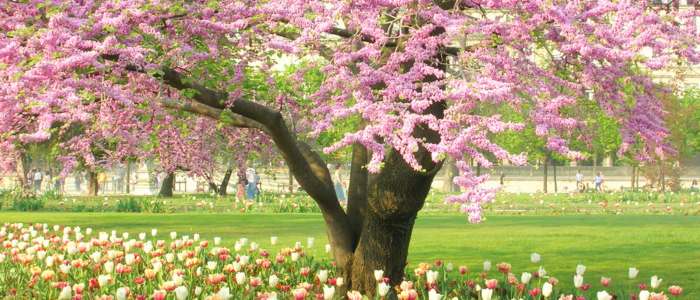
Tulip poplar (Liriodendron tulipifera) is a fast-grower that can be grown in larger areas of Maryland lawns.
Why Grow Tulip Poplar?
Tulip poplar is best grown as a shade tree in Maryland. It can also be grown as ornamentals due to its golden foliage and showy flowers.
It is adaptable to different soil types and conditions. It is easy to care for once established.
Maintenance And Care
Tulip poplar prefers full to partial sun and well-drained loamy, compost-amended soil with a pH range of 5-8.
It can be easily propagated from cuttings and requires pruning to maintain its shape. It may be affected by scales and aphids.
Click this video for features of the tulip poplar tree:
4. Red Maple

Red maple (Acer rubrum) is a fast-growing native tree that can be grown in Maryland for its landscape beauty and fall colors.
Why Grow Red Maple?
Red maple is popular among Maryland gardeners for its beautiful colors and shade.
It is easy to care for once established and live longer. It is hardy and adaptable to different growing conditions.
Maintenance And Care
Red maple requires full or partial light and well-drained, moist soil. It can be propagated using cuttings.
It is preferable to add all-purpose fertilizer in spring and occasional pruning. It can be subject to leaf spots, tar spots, and powdery mildew.
Check out this video on growing red maple trees:
5. American Holly
American holly (Ilex opaca) is a dense, pyramid-shaped, evergreen tree that opens up with age and is used as a specimen plant in Maryland.
Why Grow American Holly?
American holly can be used to add landscape beauty to Maryland.
It has lush foliage that makes the cover for songbirds and mammals. It can tolerate a different range of soil conditions.
Maintenance And Care
American holly prefers moist, well-drained soil and full sun to partial shade.
It may benefit from acidifying fertilizer early each spring and occasional pruning to improve the shape. Pay close attention to leaf miners, whitefly, and scale.
You may watch this video to know more about planting American holly:
6. Pawpaw

Pawpaw (Asimina triloba) is a small deciduous tree that produces large-sized fruits and adds tropical flavor to your Maryland gardens.
Why Grow Pawpaw?
Pawpaws can tolerate shade and survive in the understory.
Its small size makes it ideal to fit into any landscape of Maryland. It is not fussy and requires little care and adequate soil moisture.
Maintenance And Care
Pawpaws prefer well-draining soil with slightly acidic to neutral pH and full sun. It requires two different cultivars and can be propagated by grafting and cuttings.
It requires well-balanced fertilizer twice a year. Pawpaw peduncle borer is one of the troublesome pests.
The complete guide to growing pawpaw is covered here:
7. Downy Serviceberry
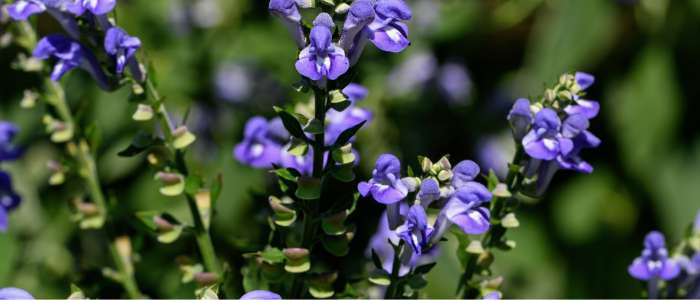
Downy serviceberry (Amelanchier arborea) is a multi-stemmed tree with white flowers and fruits that can be grown in Maryland.
Why Grow Downy Serviceberry?
Downy serviceberry is a fast-growing tree of Maryland that is preferred for its landscape beauty. It is adaptable to different soil types and conditions. It requires little care and attention once established.
Maintenance And Care
Downy serviceberry prefers full sun and well-drained, loamy soil with a slightly acidic pH. It can be propagated by seeds or softwood cuttings.
Fertilize the tree with an all-purpose fertilizer in the spring and prune them. It can be troubled by lace bugs and aphids.
You may check this video to know more about caring for serviceberries:
8. Common Bald Cypress
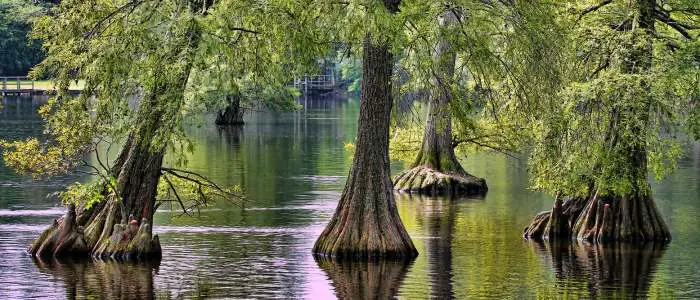
The common bald cypress (Taxodium distichum) is a deciduous conifer tree with a slender pyramidal form and leaf texture that can tolerate the climatic conditions of Maryland.
Why Grow Common Bald Cypress?
The common bald cypress has a fast-growing habit that makes it ideal to grow in Maryland.
It is used as a shade and specimen tree. It is adaptable to different soil types and can last for many centuries once established.
Maintenance And Care
Bald cypress prefers moist, acidic, sandy soil and full sun to partial shade.
It can benefit from slow-release all-purpose fertilizer in the spring. It may be affected by chlorosis in alkaline soils and cypress leaf beetle.
Check out this video for additional information on growing bald cypress:
9. River Birch

River birch (Betula nigra) is an adaptable and popular deciduous landscape tree that can flourish in Maryland.
Why Grow River Birch?
River birch is a fast-growing tree often grown as a landscape tree in lawns for its unique bark, fall color, and habitat. It is popular as a shade tree. It is easy to care for and undemanding once established.
Maintenance And Care
River birch prefers full sun and well-drained soil away from the pavement.
It requires occasional fertilization if the tree shows distress and pruning in fall and winter. It may succumb to birch leafminers and bronze birch borer.
The complete growing guide of river birch is covered here:
10. American Elm

American elm (Ulmus Americana) is a large, graceful, fast-growing tree that is well-suited to Maryland’s climatic conditions.
Why Grow American Elm?
American elm can adapt to different variety of soil conditions and types of Maryland.
It is both pH and salt tolerant. It is long-lived, providing shade for the family, and requires little care once established.
Maintenance And Care
American elm prefers deep, rich soils and full sun or partial shade. Mulch using dark mulch and fertilize using a layer of compost in spring.
It requires vigilant pruning and frequent spraying. The common pests include elm leaf beetle, cankerworms, and caterpillars.
Check out this video to propagate and care for American elm:
11. Crabapple

Crabapples (Malus spp) are small flowering trees that can flourish in Maryland due to its favorable climatic conditions.
Why Grow Crabapple?
Crabapples are valued by Maryland gardeners for their wildlife value. It can adapt to different urban conditions and adds landscape beauty.
It is hardy and attracts pollinators and birds. Its compact size makes it ideal for small spaces.
Maintenance And Care
Crabapples thrive in moist, well-drained soil and full sun to partial shade. It can be propagated via softwood cuttings.
It requires pruning in late winter to remove dead or diseased branches. It is prone to scabs, cedar-apple rust, and blight.
12. Hackberry

Hackberry (Celtis occidentalis) is a fast-growing and common tree of Maryland that is known for showy foliage, hardiness, and adaptability.
Why Grow Hackberry?
Hackberry is a tough tree that can adapt to different adverse growing conditions in Maryland. It is often grown as ornamental and shade trees.
It is hardy and requires little care once established. It can tolerate strong winds and air pollution.
Maintenance And Care
Hackberry prefers rich, moist soils and full sun. It can be propagated from seeds. It requires occasional pruning in the dormant season.
It may benefit from a granular, liquid, or stake variety of fertilizer. One of the troublesome pests is hackberry lace bugs.
Check out this useful video to know more about growing hackberry:
13. Persimmon

Persimmon (Diospyros virginiana) are hardy fruit trees that can thrive throughout Maryland and is valued for its wood and fruits.
Why Grow Persimmon?
Persimmons are Maryland natives that are easy to grow and take care of in Maryland. It can tolerate a different range of soils. It is suitable for beginners and gives bounty yields of fruits.
Maintenance And Care
Persimmon grows well in well-drained, loamy soils with slightly acidic pH and partial to full sun. Apply a balanced fertilizer in late winter or early spring.
The established trees need light pruning. Its fruits can be chewed by deer, opossums, squirrels, and wild turkeys.
The complete guide to growing persimmon is covered here:
14. Pin Oak
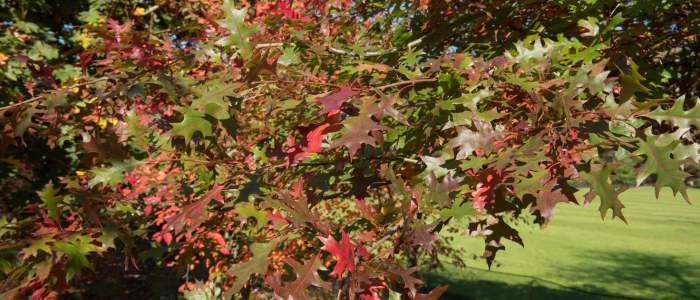
Pin oak (Quercus palustris) is a large shade tree with a pyramidal shape and can be grown in Maryland with appropriate care.
Why Grow Pin Oak?
Pin oak is an attractive tree in Maryland that is used for landscape gardening due to its glossy leaves and beautiful fall color.
It is adaptable to different soil conditions and also acts as a shade tree. It requires little care once established.
Maintenance And Care
Pin oak prefers sandy loamy soil with plenty of moisture. It can be propagated from seeds or acorns.
It requires pruning as a globe-cut tree or hedge. It can be troubled by leaf scorch, cankers, and root rot.
Click this video for tips on growing pin oak:
15. White Fringetree

White fringe trees (Chionanthus virginicus) are slow-growing trees that are grown as specimen trees in Maryland.
Why Grow White Fringetree?
The white fringe tree adds landscape beauty with large clusters of snow-white flowers. It can fit into any garden space as it grows only 10-20 feet tall.
The care for trees is simple as it doesn’t leave any mess. It can tolerate urban conditions, including air pollution.
Maintenance And Care
The white fringe tree thrives in moist, fertile soils and full sun or partial shade. Fertilize annually with a balanced fertilizer and an inch of compost.
It seldom requires pruning. One of the significant pests is emerald ash borer.
Here is a useful video for tips on growing fringetree:
What Is The Easiest Growing Tree In Maryland?
The easiest-growing tree in Maryland is flowering dogwood.
Flowering dogwood is easy to grow and care for small trees in the state. It is highly prized for its early spring flowers and tidy growth habit that can beauty to your landscape.
It can adapt to different growing conditions ranging from full shade to full sun. The other trees that can be grown with minimal care and maintenance are American sycamore and tulip polar.
What Is The Best Time To Plant Trees In Maryland?
The best time to plant trees in Maryland is fall and early spring. It can also be planted in winter if the soil is not frozen.
Experts do not recommend planting in summer when the plants are in full leaf. Trees with fleshy roots, including dogwoods and tulip poplar can be planted in spring.
The broadleaf evergreens are best started in early fall. Many balled, burlapped, and container trees can be planted at any time of the year.
FAQs
The different fast-growing trees that thrive in Maryland are loblolly pine, eastern white pine, tulip poplar, pin oak, common bald cypress, honey locust, and American elm. It helps in developing established trees in a few years.
The common pine tree in Maryland’s southern coastal plain is loblolly pine. It is highly adaptable and easy to care for once established. It is an evergreen tree that can tolerate different soil types and conditions.
The different flowering trees that can grow in Maryland are Jane magnolia, American linden, Green spire linden, purple robe locust, bonfire peach, and lavender chiffon rose of Sharon shrub. These trees add beauty with its blossoms and attract bees and butterflies.
Quick Recap: Top Trees to Plant In Maryland
Here is a quick recap of the top trees that can adapt to Maryland’s climate:
| Trees | Why Grow? |
|---|---|
| Flowering dogwood | 1. Planted for showy spring flowers and red fall foliage 2. Adaptable to different growing conditions |
| American sycamore | 1. Fast growth rate and good shade tree 2. Tolerates well soil, pollution, and wind |
| Tulip poplar | 1. Landscape specimen tree of Maryland with a fast growth rate 2. Requires little care once established |
| Red maple | 1. Adds landscape beauty and shade to Maryland home gardens 2. Requires little care once established |
| American holly | 1. Popular evergreen tree of Maryland home gardens 2. Tolerates different soil types |
| Pawpaw | 1. A deciduous tree that can add landscape beauty to Maryland 2. Undemanding and requires little care |
| Downy serviceberry | 1. Adaptable, easy-to-grow, and fast-growing trees of Maryland 2. Requires little care once established |
| Bald cypress | 1. Can be grown as shade and landscape specimen tree 2. Adapt to different soil types and conditions |
| River birch | 1. Popular as a shade tree in Maryland 2. Undemanding and requires little care once established |
| American elm | 1. Long-lived and shade tree of Maryland 2. Adaptable to different soil types and requires little care |
| Crabapples | 1. The compact size makes it suitable to grow in Maryland home 2. Tolerate different soil conditions and adds landscape beauty |
| Hackberry | 1. Hardy and the low-maintenance tree of Maryland 2. Adapt to different growing conditions and soil types |
| Persimmon | 1. Easy to grow and care for fruit trees of Maryland 2. Ideal for beginners and requires low-maintenance |
| Pin oak | 1. Fast-growing and hardwood deciduous trees suitable for Maryland 2. Attractive pyramidal shade and ornamental value |
| White fringe tree | 1. Deciduous landscape beauty with white blossoms 2. Easy to care for and tolerates urban conditions |
Bottom line
Hopefully, this guide has given you certain tips and considerations in choosing and caring for trees in Maryland home gardens.
Have any questions? Please write to us!
Do share the guide with your friends and family!