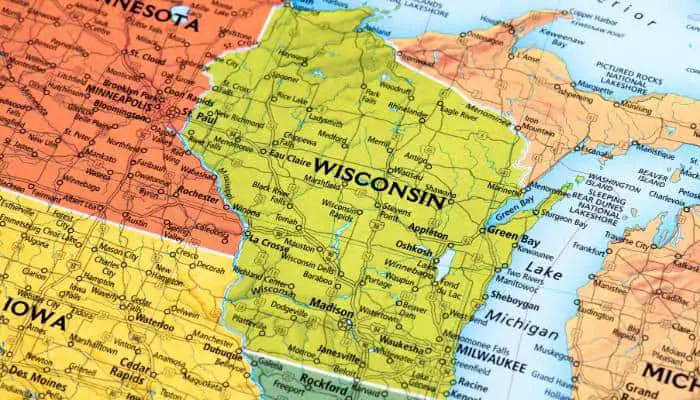
Wisconsin is a state located in the Midwestern region of the United States.
The state’s agricultural industry contributes a significant amount to its economy, with Wisconsin ranking as one of the top ten states in the nation for total agricultural production.
Wisconsin is known for its diverse array of crops and livestock, with dairy products being particularly important to the state’s economy.
Plant Hardiness Zone Map
Firstly, let us have a look at the US Plant Hardiness Zone Map.
Plant Hardiness Zone Map for Wisconsin

Climate
Wisconsin has a humid continental climate with warm to hot summers and cold winters.
While most of the state is of subtype warm-summer, the southern part falls under the hot-summer subtype.
Summer has comfortable temperatures in Wisconsin, with the mercury column rarely touching 90°F.
Winters are cold, snowy, and temperatures around -30°F are common in the northern counties.
Precipitation
The northern highlands and western uplands receive snowfall up to 160 inches, while the rest of the state averages 40 inches.
Rainfall averages 35 inches in the state, with the northwest significantly wetter than the south and east.
Soil Type
The map showing the distribution of the soil orders in the state is as follows:-

Now, we’ll elaborate on this map with the help of a table.
Soil Order Of Wisconsin
| Soil / Sub Order | Location | Characteristics |
|---|---|---|
| Alfisols/Udalfs | In the western eastern and southern regions of the state | 1. Udalfs have a udic moisture regime. |
| Entisols/Aquents and Psamments | In the northeast sands, western coulee and ridges, and central sand plains | 1. Aquents are the wet Entisols. 2. Psamments are sandy soils. |
| Histosols/Saprists | Scattered as small patches across the state. | 1. Saprists are the wet Histosols in which the organic materials are well decomposed. |
| Inceptisols/Aquepts and Udepts | Aquepts in the central sand plains and Udepts in the western Coulee and ridges and northwest lowlands. | 1. Aquepts are wet Inceptisols that require artificial draining due to their poor natural drainage. 2. Udepts are mainly freely drained Inceptisols that have a udic or perudic moisture regime. |
| Mollisols/Udolls | In the southern part of the state. | 1. Udolls are the more or less freely drained Mollisols of humid climates. |
| Spodosols/Orthods | In the northern part of the state. | 1. Orthods are the relatively freely drained Spodosols that have a moderate accumulation of organic carbon in the spodic horizon. |