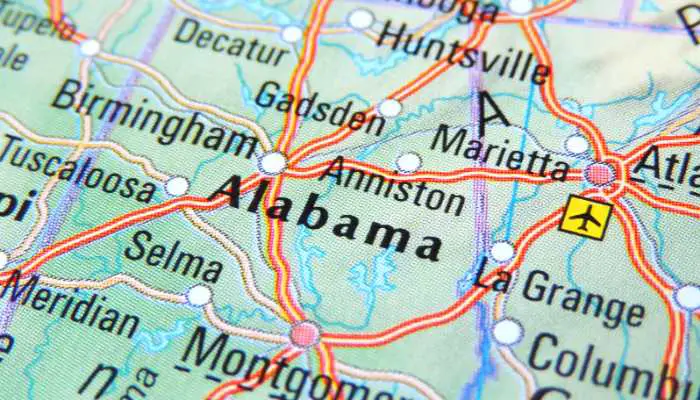
Alabama’s agriculture is as diverse as the state’s landscape.
From the fertile Black Belt soils that give birth to cotton and peanuts to the rolling hills and valleys that are home to cattle and chicken farms, Alabama farmers produce a variety of crops and livestock.
The state’s climate also lends itself to a wide range of agricultural production.
Warm temperatures and long growing seasons allow for the year-round production of many fruits and vegetables, while cooler temperatures in the northern part of the state are ideal for growing winter wheat.
Plant Hardiness Zones for Alabama
Before moving forward, let us take a glance at the US Plant Hardiness Zone Map of the state of Alabama.
Plant Hardiness Zone Map for Alabama

Climate
The climate in the state of Alabama is of humid subtropical type with very hot summers, mild winters, and precipitation throughout the year.
Summers usually have average temperatures above 90°F, and therefore, the state is considered among the hottest in the United States.
Winters are mild to cold, with average low temperatures below freezing in the northeast.
The central and southern parts have relatively mild temperatures.
Precipitation
The annual average precipitation is 56 inches and occurs throughout the year.
The coast is wetter than the interior, with frequent thunderstorms and tropical storms in the summer.
Snowfall is rare but occurs chiefly in the northern mountainous region of Alabama in the winter.
Soil Type
The below map shows the soil regions of the state.
Soil Regions of Alabama

Now, we will understand the soil order of the state in these regions with the help of a table.
Soil Order Of Alabama
| Soil / Sub Order | Location | Characteristics |
|---|---|---|
| Ultisols / Udults | Found all over the state. | 1. Udults are the more or less freely drained, relatively humus-poor Ultisols that have a udic moisture regime. |
| Inceptisols / Aquepts and Udepts | Aquepts in the major floodplains and terraces and Udepts in parts of the coastal plain. | 1. Aquepts are wet Inceptisol 2. Udepts are mainly freely drained Inceptisols that have a udic or perudic moisture regime. |
| Entisols / Aquents and Fluvents | Aquents in the coastal plains and Fluvents in a small part of limestone valleys and uplands. | 1. Aquents are the wet Entisols. 2. Fluvents are the more or less freely drained Entisols that formed in recent water-deposited sediments. |
| Vertisols / Uderts | In the coastal plains. | 1. Uderts are the Vertisols of humid areas. They have cracks that open and close, depending on the amount of precipitation. |
| Alfisols / Udalfs | In some parts of the Appalachian plateau | 1. Udalfs have a udic moisture regime. |